
 By Salary by Career
America’s fastest-growing occupation does not involve a laptop, a corner office, or much opportunity to work in sweatpants. Wind turbine technician spends days climbing towers, inspecting equipment, diagnosing electrical and mechanical problems, and repairing machines that can place them hundreds of feet above the ground.
Bureau of Labor Statistics projections put employment growth for wind turbine service technicians at 49.9% between 2024 and 2034, faster than any other occupation in its latest projections. Solar photovoltaic installers rank second at 42.1%.
Strong demand is only part of the attraction. Workers can enter the field without committing four years to a traditional college degree.
Of course, skipping the bachelor’s degree does not mean skipping training. Heights, travel, physical work, safety requirements, and unpredictable repair calls come with the paycheck.
A 49.9% growth rate surely sounds spectacular.
What Does “Fastest-Growing” Really Mean
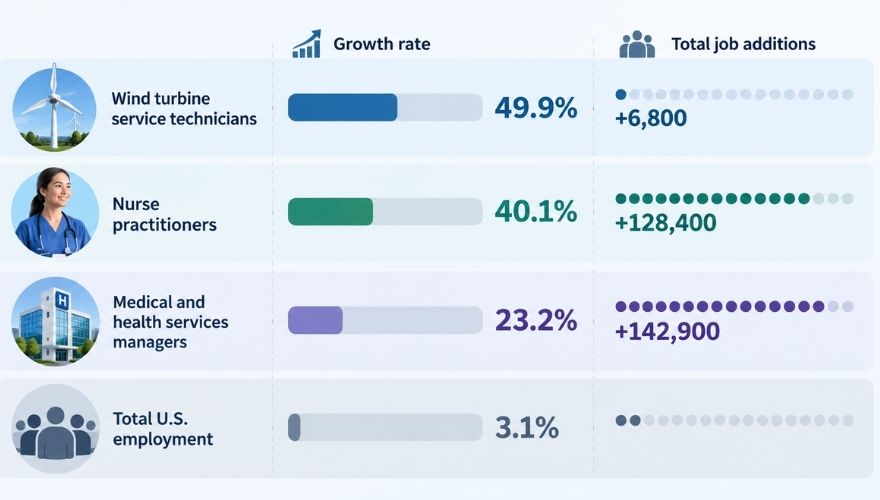
BLS expects wind technician employment to increase by roughly 6,800 jobs over the decade.
For a relatively small occupation, adding that many workers is substantial. Yet it is not the same thing as a profession hiring another 100,000 people.
Nurse practitioners offer a useful comparison. Their employment is projected to rise 40.1%, slightly slower than wind technicians, while adding about 128,400 jobs.
Medical and health services managers provide an even sharper contrast. Employment in that occupation is projected to increase 23.2%, yet BLS expects roughly 142,900 additional jobs.
Percentage growth and job creation are answering two different questions.
Fastest-growing tells you how quickly the neighborhood is expanding. It does not tell you how big the neighborhood is.
Context makes 49.9% impressive all the same. Total U.S. employment is projected to increase just 3.1% during the same period. Wind technician employment is growing at a pace many occupations will not come close to matching.
Anyone considering the career should still pay attention to both numbers.
Growth rate says demand is rising quickly. Job additions tell you how many seats might actually be available.
Why Demand Is Rising
Every turbine installed today creates work that continues after the construction crews leave.
Technicians inspect blades, brakes, electrical systems, generators, and other components. Problems have to be diagnosed, worn parts replaced, and mechanical failures repaired.
A wind turbine does not become maintenance-free once somebody bolts it together and switches it on.
Older equipment adds another source of work.
Large numbers of turbines installed during earlier periods of wind development are reaching ages when parts need additional attention.
Components wear out. Electrical systems develop faults. Blades require inspection and repair.
That matters because technician demand is not tied entirely to construction of new wind farms.
Among wind-sector employers involved in repair and maintenance, 56% described hiring qualified employees as very difficult in a federal workforce survey. Another 22% called it somewhat difficult.
Even during a slower period for new installations, existing turbines still need somebody willing to climb up and figure out why one has stopped producing electricity.
Maintenance has a nice feature if you are looking for job security: machinery rarely develops an interest in fixing itself.
Training Is Shorter, but It Is Still Training
Compared with professions requiring a bachelor’s degree, the path into wind technology can be relatively short.
Technical programs commonly take one to two years, and some workers enter after gaining experience in electrical work, industrial maintenance, or mechanical trades.
Pay can make that route worth a closer look.
Median annual earnings were $57,320 in May 2022. Reported estimates placed entry-level earnings near $40,000, while experienced workers could earn more than $103,000.
A salary above $100,000 represents the experienced end of the occupation, not what a new technician should expect to collect after finishing training. Median pay gives a better picture of what a typical worker was earning.
New technicians also need substantial instruction after getting hired. About 12 months of on-the-job training has been reported for workers entering the occupation.
So the useful question is not simply, “Can I get into this without college?”
A better one is, “What replaces college?”
Here, the answer includes technical schooling or relevant trade experience, extensive safety instruction, hands-on training, and the ability to work comfortably in conditions many people would rather observe through a window.
Salary Comes With Some Serious Trade-Offs
Wind technicians do not earn their money by occasionally tightening a bolt while enjoying the scenery.
Turbine towers commonly rise 100 feet or more, putting technicians well above the point at which most people start reconsidering their career plans.
Remote work sites and confined spaces can also be part of the job.
Travel may be routine, especially for technicians responsible for equipment spread across multiple sites.
Physical demands add another consideration. Workers can encounter extreme weather and may need to carry roughly 50 pounds of equipment while climbing long ladders.
Repairs also have a habit of ignoring neat schedules.
Equipment failures can turn an ordinary workday into a longer one, particularly when a turbine needs urgent attention.
None of that makes the occupation a bad bargain. It explains why comparing its salary with an ordinary desk job misses part of the calculation.
Workers are being paid for technical ability, physical capability, safety discipline, and a willingness to do skilled industrial work in places most people cannot comfortably reach.
Wind capacity is concentrated heavily in states such as Texas, Iowa, Oklahoma, and California, which means job opportunities are not distributed evenly across the country.
Someone interested in the occupation may therefore have to consider relocation or regular travel alongside pay and training costs.
A one-year technical program looks quite different if the first good job offer happens to be several states away.
Growth Is a Forecast, Not a Guarantee
Current projections are not the first time wind technicians have appeared near the top of the employment-growth rankings.
An earlier BLS forecast covering 2022 to 2032 projected 44.9% growth for the occupation. Current projections put growth at 49.9% for 2024 to 2034.
Seeing the occupation rank highly across successive forecasts strengthens the case that its growth is more than a one-year statistical curiosity.
Forecasts still have limits.
Wind employment depends partly on investment in new projects, financing conditions, tax policy, interest rates, energy demand, and broader economic conditions. Changes in any of those areas can alter hiring.
Nobody preparing an employment projection can know exactly how many turbines developers will order years into the future.
BLS can tell us where labor demand appears to be heading based on current information and expected economic conditions. Workers still have to make decisions in a world that occasionally ignores spreadsheets.
Closing Thoughts
Wind turbine technician deserves its place near the top of the occupational-growth rankings.
Projected employment growth of 49.9%, relatively short training pathways, and potentially solid earnings create a combination that will attract people who want skilled technical work without committing to a four-year degree.
Still, 6,800 additional jobs is the number worth keeping next to that 49.9% headline.
Wind technicians make up a small occupation growing very quickly. America is not suddenly preparing to employ hundreds of thousands of them.
For someone comfortable with heights, mechanical work, travel, and demanding conditions, that smaller job market may still offer a worthwhile opportunity.
A 49.9% growth rate tells you how quickly the occupation is moving. Training requirements, pay, geography, and a 200-foot climb tell you what joining it actually costs.