
 By Salary by Career

Applying for a job used to involve a fair amount of guesswork.
You knew what the company wanted. Finding out what it would pay could take several interviews, a few awkward conversations, and occasionally an offer that made the entire process feel like a waste of time.
As of October 2026, 16 states and Washington, D.C., have pay transparency laws requiring employers to disclose compensation information at some point during hiring.
Fourteen states and D.C. require pay information in covered job postings, while Nevada and Rhode Island have different disclosure rules.
Knowing the salary upfront sounds like an obvious improvement.
But does it actually help workers earn more, or does it simply make disappointing job offers easier to avoid?
Which 16 States and DC Require Pay Transparency?
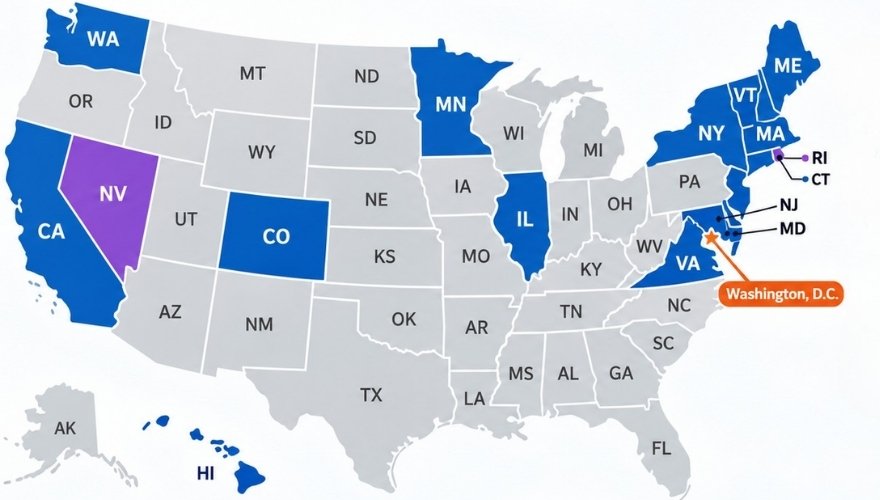
Pay transparency laws operate differently across the country. Some states require salary information in job advertisements, while others allow employers to disclose it later in the hiring process.
As of October 2026, 14 states require salary or wage information in covered job postings:
- California
- Colorado
- Connecticut
- Hawaii
- Illinois
- Maine
- Maryland
- Massachusetts
- Minnesota
- New Jersey
- New York
- Vermont
- Virginia
- Washington
Washington, D.C., also requires compensation information in covered job advertisements.
Nevada generally requires employers to disclose wage ranges after applicants complete an interview.
Rhode Island requires disclosure upon an applicant’s request and at hiring, with additional protections for existing employees.
Several changes took effect in 2026. Virginia introduced posting requirements on July 1, Maine followed on July 29, and Connecticut expanded its disclosure rules on October 1.
Employer size matters, too. California’s Equal Pay Act requires employers with at least 15 employees, including at least one in California, to include pay scales in covered advertisements.
Massachusetts generally sets its threshold at 25 employees, while Virginia’s requirement applies to employers regardless of size.
A small business could therefore face different obligations depending on where it operates and hires. No nationwide federal law currently requires salary ranges in all job postings.
What Employers Actually Have to Reveal
Most posting requirements call for an hourly wage, annual salary, or a good-faith compensation range. Employers generally cannot satisfy those requirements by describing pay as “competitive.”
Consider a marketing position advertising $70,000 to $90,000 annually. Applicants know the potential pay before submitting a resume, but several questions are still unanswered.
Would the employer realistically offer $88,000? Does the upper end apply only to candidates with extensive experience? Could a qualified applicant receive an offer near the minimum?
A good-faith range should represent what the employer reasonably expects to pay. California specifically requires an estimate of compensation expected upon hiring, rather than an arbitrary range covering every possible future salary.
Certain states require additional details. Colorado requires descriptions of benefits, bonuses, commissions, and other compensation, along with an expected application deadline.
Connecticut’s expanded October 2026 rules require wage information and a general benefits description in internal and public job advertisements.
Coverage can also extend to promotions, transfers, and remote positions. For instance, California’s Labor Commissioner’s Office interprets its posting rule to cover positions that could be filled by someone working in California, including remotely.
A published range establishes a starting point for compensation discussions, not a guaranteed offer.
How Pay Transparency Changes the Job Search

Biggest practical improvement? Applicants can decide which opportunities deserve their time before getting involved in the hiring process.
Imagine an accountant earning $85,000 who discovers a promising position advertising $60,000 to $75,000. Unless the role offers unusually valuable benefits or better working conditions, applying may make little financial sense.
Salary disclosure also gives candidates a better negotiating position. Instead of guessing what an employer might accept, applicants can discuss compensation within an established budget.
Understanding how pay changes across a career can also help workers evaluate whether a new job offer represents a meaningful improvement in their earning potential.
Research suggests the benefits may extend to wages themselves.
A November 2025 National Bureau of Economic Research working paper examined state-level salary disclosure requirements.
Researchers found that the policies increased the share of job postings containing salary information by approximately 30%.
More interestingly, their analysis identified wage increases of 1.3% to 3.6% across three datasets. Researchers found no measurable effects on employment or pay dispersion in their analysis.
For someone earning $80,000 annually, an increase of 1.3% to 3.6% would equal approximately $1,040 to $2,880 in additional annual pay.
That calculation shows the size of the research findings, not a raise every individual worker can expect. Results describe broader labor market effects, and the study was published as a working paper.
Greater salary visibility may also encourage existing employees to question compensation differences. Employers advertising higher wages for new hires could face uncomfortable questions about what current workers earn.
Salary transparency doesn’t automatically produce equal pay, but it makes certain differences harder to ignore.
Why Salary Transparency Isn’t Always So Transparent
A salary range stretching between $60,000 and $150,000 is certainly transparent about one thing: the company has left itself plenty of room.
Such a posting contains a $90,000 spread. An applicant hoping for $130,000 could discover after several interviews that the company intends to offer considerably less.
Wide ranges aren’t automatically illegal. Employers may have legitimate reasons for flexibility, including different experience levels and qualifications. Still, ranges must meet applicable state requirements, including good-faith standards.
Another issue is compliance.
A Federal Reserve Bank of New York analysis published in October 2025 found that roughly one-quarter of covered online job advertisements in early-adopting jurisdictions lacked required salary information.
Liberty Street Economics

Researchers couldn’t establish why employers omitted the information. Some may have misunderstood their obligations, while others may have chosen not to disclose pay.
Compensation packages add another complication.
A $90,000 salary with excellent health insurance, generous retirement contributions, and substantial paid leave could be financially preferable to a $95,000 position offering fewer benefits.
Employers also face practical complications when recruiting across state lines. A remote job advertised nationally may trigger disclosure obligations in multiple jurisdictions, each with its own coverage rules.
For workers, the important distinction is between knowing an advertised salary and knowing the actual financial value of an offer.
Closing Thoughts
Pay transparency laws have made an ordinary part of job hunting considerably more practical.
Applicants in covered positions can evaluate compensation before committing hours to interviews, while employers must think more carefully about how they communicate pay.
Still, an advertised salary range cannot explain every benefit, predict a final offer, or guarantee a raise.
Knowing the salary range won’t tell you if a job is worth taking. But it can help you decide if it’s worth applying for. That’s a useful number to have before the first interview.